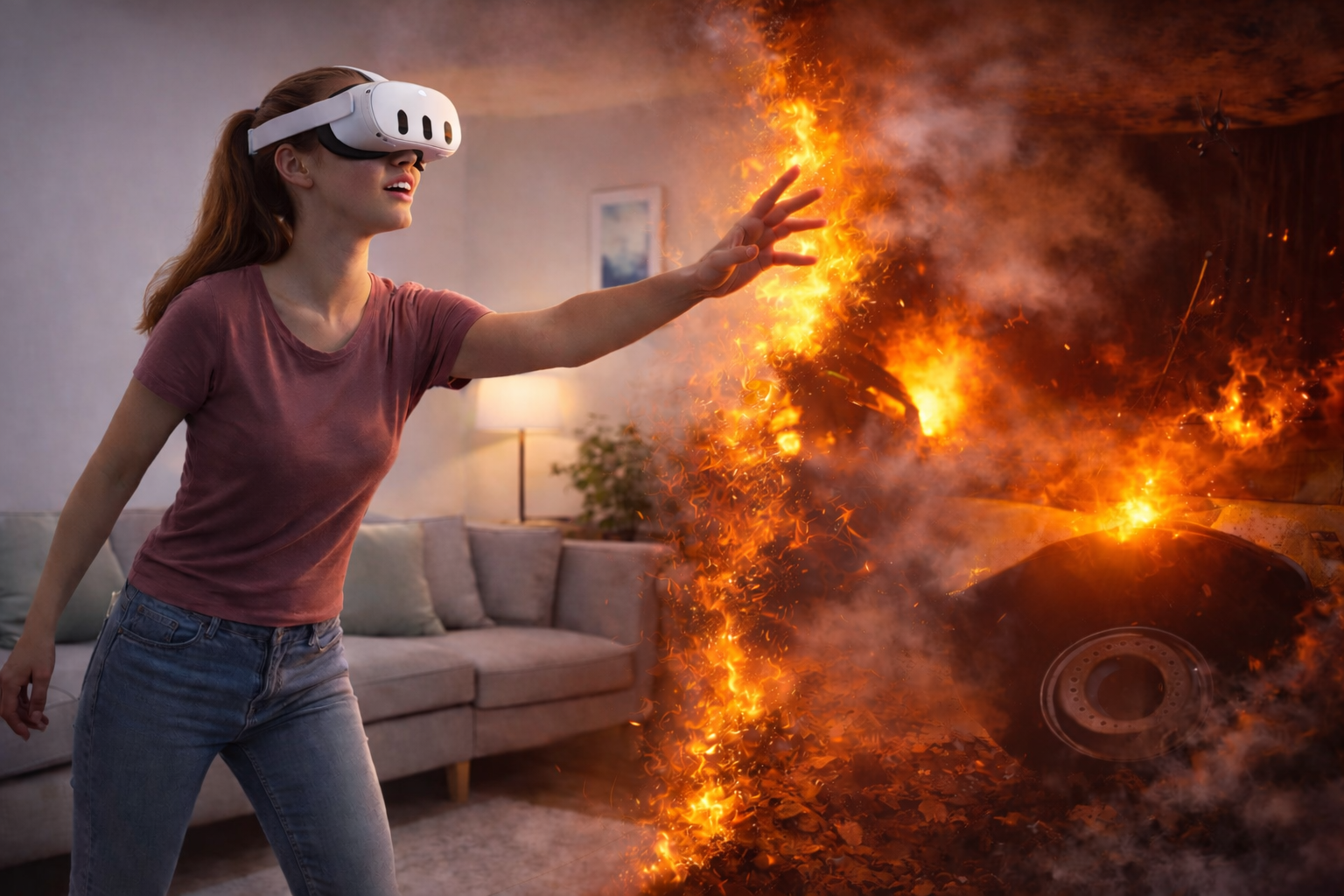
VIRTUAL REALITY TRAINING SOLUTIONS
bizAR Reality designs and deploys custom virtual reality training for mining, logistics, manufacturing, construction, energy and safety-critical industries. Each solution can be configured around your specific procedures, environments and operational requirements.
CHALLENGES VS SOLUTIONS
KEY FEATURES
HIRA & Hazard Identification
Workers enter a virtual workplace to identify hazards, assess risks and practise control measures before encountering actual site conditions.
Lockout / Tagout (LOTO)
Practise energy isolation and LOTO procedures on virtual equipment to build procedural competency before working on live systems.
Working at Heights
Scaffold safety, MEWP operation and fall prevention training without real height exposure — repeatable scenarios for emergency response at height.
Fire Safety & Emergency Response
Extinguisher selection, evacuation procedures and emergency response practised in a controlled virtual environment that can be reset and repeated.
Equipment & Vehicle Operation
Train operators on virtual representations of heavy equipment, mining machinery and vehicles without removing assets from production.
Site Safety Inductions
Familiarise workers with a virtual replica of your actual site before first access — covering site layout, hazard locations and emergency routes.
Standalone & Offline Capable
bizAR Reality's VR training systems can be configured for standalone headset operation, with training content preloaded for use in remote, underground or offline environments.
Facilitator-Led Group Sessions
Where group training is required, bizAR Reality's systems support facilitator-managed multi-headset sessions with real-time session control and performance recording.
What Is Virtual Reality Training?
Virtual reality training uses head-mounted displays and simulated environments to give workers immersive practice in realistic scenarios — without requiring every exercise to occur in the live operational environment. Inside a controlled virtual environment, learners can rehearse procedures, practise decision-making and encounter hazard scenarios at a level of detail that reflects actual site conditions. The training environment can be reset, repeated and assessed without the constraints of physical equipment, site access or real-world consequences.
VR Training for Safety-Critical Industries
Industries where live training carries genuine risk have the most to gain from simulation-based approaches. When a worker can practise a confined space entry, emergency evacuation or equipment fault response in a virtual environment first, they develop procedural familiarity before real exposure occurs. The consistent, repeatable nature of virtual simulation means training standards can be maintained across sites, shifts and instructors without depending on equipment availability or site access windows.
- →Mining: underground navigation, machine operation, emergency response and hazard recognition in simulated mine environments
- →Logistics and fleet operations: vehicle pre-start checks, load management and driver safety procedures
- →Manufacturing: equipment operation, LOTO procedures and incident response without removing assets from production
- →Construction: working at heights, scaffold safety, MEWP operation and site inductions
- →Energy and utilities: safe isolation procedures, emergency response and hazard identification
- →Industrial operations: HIRA, fire safety and confined space training across a range of facility types
How a bizAR VR Training System Works
Each bizAR Reality VR training system is developed or configured to the client's operational context. The process typically begins with defining training objectives and SOP requirements before moving into environment and scenario development. Standalone configurations operate directly on supported headsets with content preloaded for use without an internet connection. Facilitator-led configurations support multiple headsets managed from a tablet or laptop over a local network. Reporting exports and LMS integration can be included depending on project scope.
- →Training objectives and SOP requirements are defined
- →Virtual environments, equipment and scenarios are developed or configured
- →Deployment model is confirmed — standalone offline, facilitator-led multi-headset, or a combination
- →Learners complete immersive training sessions
- →Assessment and completion data is recorded where performance tracking is implemented
- →Reporting, export formats and LMS integration are scoped and delivered where required
COMMON QUESTIONS
Answers to questions training managers, safety officers and operations leaders commonly ask when evaluating VR training.
WHAT OUR CLIENTS SAY
"The solution reinforced BME’s positioning as an innovative and forward-thinking brand, particularly in how we engage with clients on exhibition and conference platforms."
Lollitta Pitso
Head of Marketing & Communications at BME
RELATED SIMULATORS
bizAR Reality also offers purpose-built training simulators that can be deployed as standardised products or configured to your specific requirements.